The First Battle of Bull Run (First Manassas), July 21, 1861
Click to load the video from YouTube (privacy-enhanced mode). Or watch on YouTube ›
On the afternoon of July 21, 1861, on Henry Hill in Virginia, Union Captain Charles Griffin saw a regiment step out of the woods toward his cannon and ordered canister. His superior rode up: "Captain, don't fire there; those are your battery support!" Griffin was overruled. About seventy yards out, the regiment, the Thirty-third Virginia, leveled its muskets and fired. "That was the last of us," Griffin later testified. "We were all cut down."
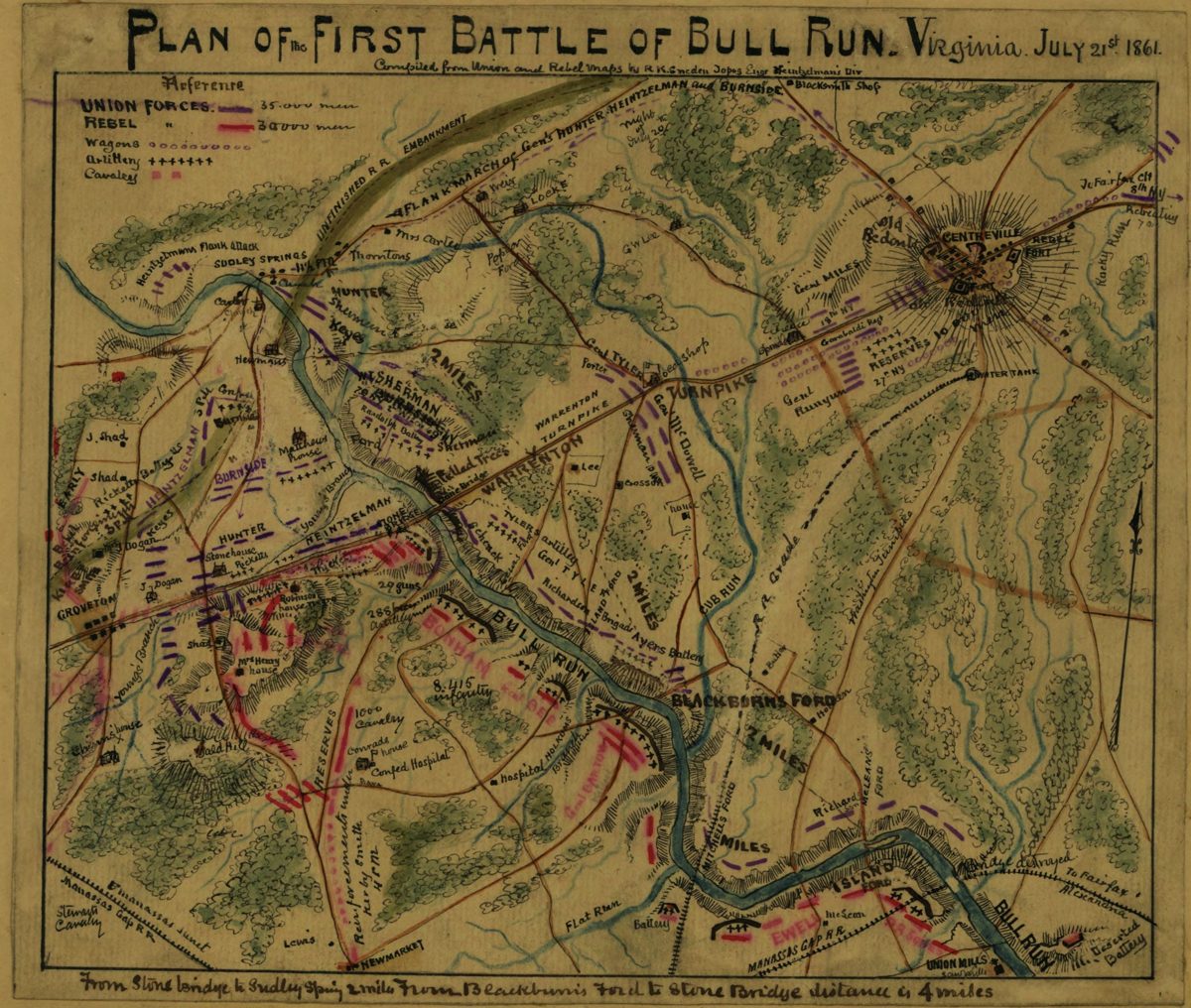

Bull Run was the first great battle of the Civil War, and both sides expected it to end the war. With ninety-day enlistments running out and the New York Tribune crying "Forward to Richmond!", Lincoln told General Irvin McDowell, "You are green, it is true; but they are green, also; you are green alike." McDowell marched about 35,000 men toward the rail junction at Manassas, where Pierre Beauregard waited behind Bull Run with about 22,000. But a second Confederate army under Joseph Johnston slipped out of the Shenandoah Valley, and over three days its brigades rolled into Manassas by train. It was the first time a railroad had helped decide an American battle.
McDowell's plan was to feint at the Stone Bridge while two divisions swung upstream through Sudley Ford onto the Confederate flank. That very morning, a Pennsylvania regiment and a New York battery whose time was up marched home "to the sound of the enemy's cannon." A guide took a wrong fork, and eight miles away, signal officer Porter Alexander caught a glint of sun on brass and flagged a warning: "Look out for your left. Your position is turned."
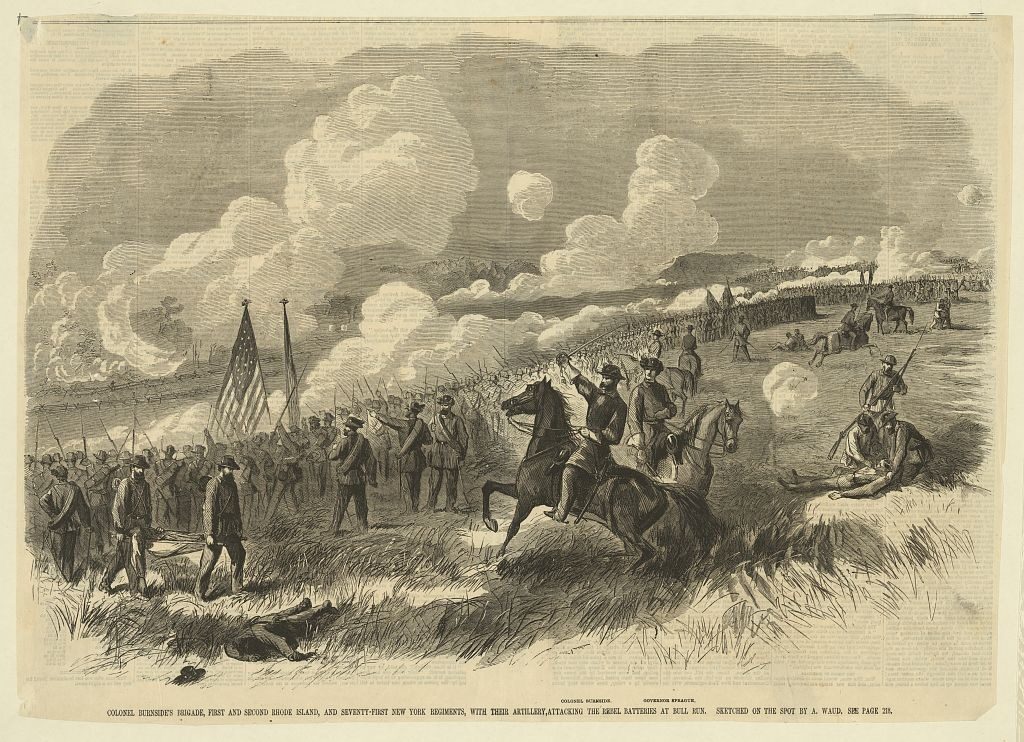
The flank attack nearly worked anyway. Confederates were driven back to Henry Hill, where eighty-five-year-old Judith Henry, bedridden in her farmhouse, was mortally wounded, the only civilian killed in the battle. Behind the crest waited Thomas Jackson's Virginians. General Barnard Bee said something about Jackson and a stone wall; no two witnesses agreed on the words, and Bee died without explaining them. The name stuck anyway. Around four, Jubal Early's brigade and Kirby Smith's men, just off the train, struck the Union flank, and the retreat became, in McDowell's words, "a panic." A shell overturned a wagon on the Cub Run bridge, and civilians who had come out from Washington to watch fled with the army; one congressman spent five months in a Richmond prison.
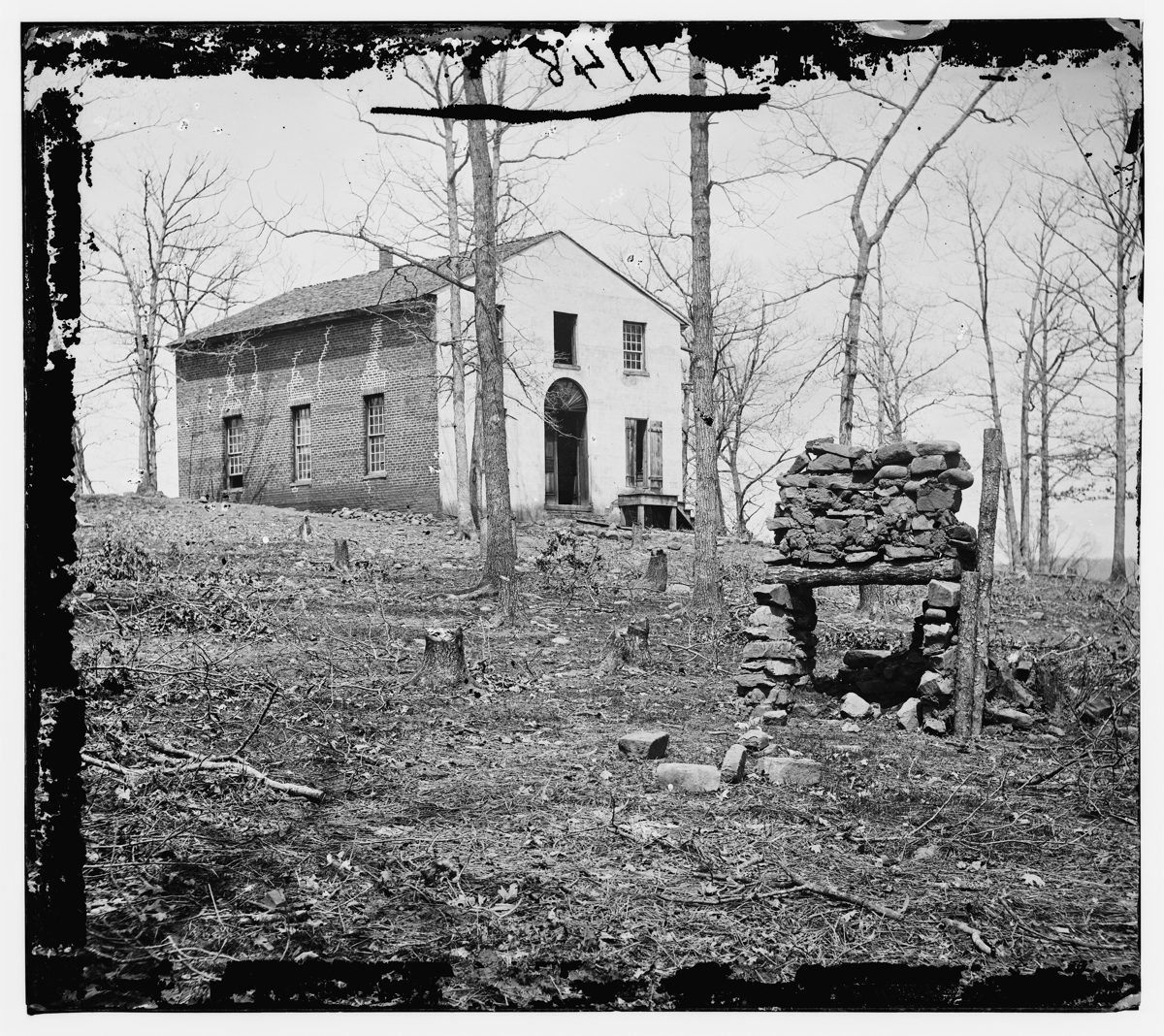
Major Sullivan Ballou of the Second Rhode Island lost a leg to a cannonball and died about a week later at Sudley Church. The famous farewell letter to his wife Sarah first appeared in print in 1868; no copy in his hand has ever been found, and some historians wonder whether he wrote it. When Rhode Island's governor came for his body in 1862, the grave was empty. According to local witnesses, Georgia soldiers had dug up the body, thinking it was the regiment's colonel, and burned it.

Further reading
- Stonewall Jackson: The Man, the Soldier, the Legend, by James I. Robertson Jr.
- The First Battle of Manassas: An End to Innocence, by John J. Hennessy
As an Amazon Associate I earn from qualifying purchases.
Sources
- Capt. Charles Griffin and Gen. Irvin McDowell testimony, Report of the Joint Committee on the Conduct of the War (1863); Gov. William Sprague's report, April 30, 1862
- Official Records of the Union and Confederate Armies, Ser. I, vol. 2: McDowell's report (August 4, 1861) and Gen. Robert Patterson's dispatches
- Horatio Rogers, chapter on Sullivan Ballou in Brown University in the Civil War (1868)
- E. Porter Alexander, Southern Historical Society Papers, vol. 16; Charleston Mercury, July 25, 1861; New York Tribune, June–July 1861
- Alfred Ely, Journal of Alfred Ely, a Prisoner of War in Richmond (1862); Act of July 22, 1861 (12 Stat. 268)
- John J. Hennessy, The First Battle of Manassas: An End to Innocence (1989); William C. Davis, The First Battle of Manassas (NPS Civil War Series, 1995)
- James I. Robertson Jr., Stonewall Jackson: The Man, the Soldier, the Legend (1997)
- National Park Service: Manassas Handbook 15, “My Very Dear Wife,” and “An Innovative Technology of War”; Lincoln Home National Historic Site
- Robert Grandchamp and Evan C. Jones, HistoryNet; Rhode Island Historical Society, Mss 277; Mr. Lincoln's White House